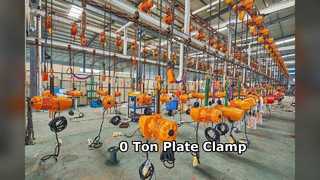
Brief: Looking for a straightforward way to solve lifting challenges in hazardous areas? This video provides a detailed walkthrough of the explosion-proof chain pneumatic air hoist for 10-ton loads. You'll see how it operates safely in explosive environments, learn about its precise control features, and discover its advantages over electric alternatives for continuous, reliable performance.
Related Product Features:
Explosion-proof and intrinsically safe design eliminates explosion risks by generating no electric sparks, meeting Hazardous Area Class I requirements.
Capable of continuous operation with a 100% duty cycle without overheating concerns for high-efficiency performance.
Highly resistant to harsh conditions including acid, alkali, steam, high humidity, and heavy dust.
Compact and lightweight construction, weighing only 1/3 to 1/8 of equivalent capacity electric hoists.
Precise pull-rod control enables centimeter-level positioning with zero impact for accurate load placement.
Clean, eco-friendly operation with an internal lubrication system that prevents air pollution.
Robust structural design ensures reliable performance and minimal maintenance requirements.
Built-in air protection prevents sudden load drops during air supply interruptions for enhanced safety.
FAQs:
What makes this air hoist suitable for hazardous environments?
This air hoist is explosion-proof and intrinsically safe, generating no electric sparks, which completely eliminates explosion risks. It meets Hazardous Area Class I requirements, including IIC gas group and T5 temperature class, making it ideal for volatile settings.
Can this hoist operate continuously without overheating?
Yes, it is designed for continuous operation with a 100% duty cycle. Unlike electric hoists, it does not overheat, ensuring reliable performance in demanding industrial applications.
How does the air hoist ensure precise load control?
It features a pull-rod control system that enables centimeter-level positioning with zero impact, allowing for accurate and safe placement of loads in various operational scenarios.